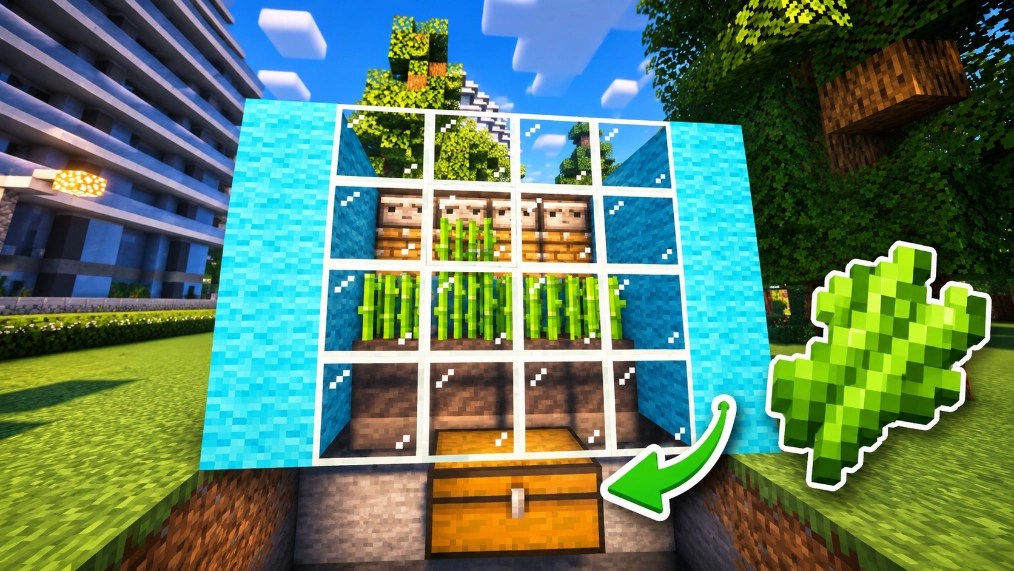
The easiest automatic sugar cane farm uses an observer, a piston and a hopper per column: plant sugar cane on mud next to water, let the observer notice when the cane reaches its third block, and let the piston knock the top two blocks into a hopper and chest while the bottom block keeps growing. On Bedrock you can go faster with a dispenser that feeds the cane bone meal, which Java does not allow.
Sugar cane is the raw material for paper, and paper is the raw material for books, bookshelves, maps, fireworks and cheap emeralds from villagers. This guide covers how sugar cane grows, the exact build for an automatic farm, the Bedrock bone meal version, and how to fix a farm that stops working. Everything is checked against the Minecraft Wiki for Java 26.3 and Bedrock 26.52.
Quick Answer
- Where it grows: sugar cane needs grass, dirt, sand, mud, moss and a few similar blocks directly beside water. Water that is only diagonal does not count.
- How fast: each plant adds one block after 16 random ticks, which is about 18 minutes on average on Java. It stops at three blocks.
- Light does not matter. Sugar cane grows in complete darkness, but only while its chunk is loaded.
- Best automatic design: observer plus piston, with hoppers under a row of mud. Keep the bottom block so the plant regrows.
- Bedrock only: bone meal instantly grows sugar cane to full height. On Java, bone meal does nothing to it.
- Scale it: a farm is just a row of identical columns. Doubling the columns doubles the output.
Sugar Cane Farm Designs at a Glance
| Design | Edition | Automation | Effort | Best for |
|---|---|---|---|---|
| Water row, harvest by hand | Java and Bedrock | None | Low | Your first few stacks |
| Observer and piston farm with hoppers | Java and Bedrock | Full | Medium | Steady paper and emeralds |
| Bone meal dispenser farm | Bedrock only | Full (you supply bone meal) | Medium | Fastest output |
| Flying machine farm | Java and Bedrock | Full | High | Huge farms; breaks if its chunks unload |
Version checked: Java 26.3 and Bedrock 26.52.
How Sugar Cane Grows
These rules come straight from the Minecraft Wiki and explain almost every problem people have with a farm.
- Soil: you can plant it on grass blocks, dirt, coarse dirt, rooted dirt, podzol, mycelium, sand, red sand, suspicious sand, moss blocks, pale moss blocks, mud and muddy mangrove roots. The soil block must touch water on one of its four sides.
- Water: the water can be covered by another block and the cane still grows. If the water is removed, the cane breaks on its next update on Java, and immediately on Bedrock.
- Growth: the top block adds one more block of height after it has received 16 random ticks. That averages about 18 minutes per block on Java, although the wiki notes the real time varies a lot. It lists about 54 minutes on Bedrock.
- Height: it only grows to three blocks tall on its own.
- Light and distance: light level is irrelevant, but the plant only grows while its chunk is loaded. If you wander far away, it stops, and the growth range depends on your simulation distance. See how to keep a chunk loaded in Minecraft and how to see chunks in Minecraft.
- Pistons: a piston that pushes a sugar cane block breaks it and drops it as an item. Pistons cannot pull it. That is the whole trick behind automatic farms.
Start With a Simple Manual Farm

If you only need a few stacks, you do not need redstone. The wiki’s compact layout puts four sugar cane around each water block, so a small area goes a long way.
- Plant the cane on a grid where every plant touches water. Four canes per water source is the most compact pattern.
- Lay lily pads over the water, or use waterlogged slabs or trapdoors in the upper half of each water block, so you can walk across without falling in.
- Place a light source under or above the water so mobs cannot spawn in the farm.
- When harvesting, walk slowly and break everything except the bottom block of each plant. Then pick up any items you missed. Creepers can hide among the plants, so keep an eye out.
A double row with a water channel between the rows works too, but it only gives two canes per water block. The wiki recommends flowing water for it, because items that fall in drift to one spot.
Build the Automatic Observer Farm
This is the design to build for a hands-off farm. The steps below follow the order of Natercade’s tutorial, “EASIEST Sugarcane Farm Ever in Minecraft 26.1 Java Edition”, which builds a four-wide farm. You can make it as wide as you like, because every column is identical.
What you need for a four-wide farm: four mud blocks (dirt or sand also work), four sugar cane, a water bucket, four pistons, four observers, redstone dust, hoppers, a few chests (the video uses three), building blocks, and glass if you want a clear front. Mud is the best soil here because items can drop through it into a hopper underneath.

How one column works, from front to back:
- At the front is the sugar cane, planted on a mud block.
- Directly behind the mud is a block of water, so the cane has its water.
- Behind that, a solid block rests above the water. On top of it sits a piston pointing at the cane, level with the cane’s second block.
- On top of the piston sits an observer pointing at the cane, level with where the third block appears.
- Behind the piston is a solid block with redstone dust on top of it, right behind the observer’s back.
- Under the mud is a hopper feeding a chest.
Step-by-Step Build
Follow these steps in order. Build one column first, then repeat it sideways to make the farm as wide as you like.
- Lay the mud
Place four mud blocks in a row. You can make the row as wide as you like.
- Wall off the water
Right behind the mud, use building blocks to wall off a row where the water will go, then fill it with water so every mud block touches it.

- Plant the sugar cane
Place one sugar cane on top of each mud block.

- Place the pistons
Fill in the space behind the water with building blocks and build two more blocks up. Then place a piston on each column, aimed at the sugar cane.

- Place the observers
In front of the first piston, place one block and then another block on top of it. Place an observer on top of the piston, facing into that block. Do the same for the rest of the columns.

- Check the observers
Go to the front and break those temporary blocks. If you can see the eyes of the observers facing you, they are pointing the right way.

- Add the redstone
Go around behind the pistons. Place four blocks behind the pistons, then put redstone dust on top of them.

- Enclose the farm
Build blocks around the machine so nothing glitches through, and extend two more blocks out so a single block does not glitch through. Then place glass across the front, from the bottom all the way to the top.


- Dig the collection hole
Go underneath and clear a hole two blocks deep, all the way under the mud.

- Add the hoppers and chests
Place a block under the glass and put a chest on top of it. Add as many chests as you want. Lead a hopper into the back of the first chest, then sneak and place the other hoppers so they all feed into each other. For the other chests, dig down behind each chest and lead into it, so they fill up one after another.

- Test the farm
Speed the game up with
/tick rate 10000(Java only), then watch the cane grow and break at the top and check the chests. Set it back with/tick rate 20afterwards. On Bedrock, use the random tick speed command in the next section instead. You can also throw a sugar cane onto a mud block first to confirm it drops into a chest.

Why it works: when the cane grows its third block, the observer sees the change and sends a pulse. The piston pushes the second block, which breaks it. The block above loses its support and drops too, so both fall as items through the mud into the hopper. The bottom block stays, and the cycle restarts.
Test It Before You Walk Away
Do not wait 18 minutes to find out whether it works. Speed the game up in a test world, watch the cane grow and get harvested, then put it back to normal.
- Java, fastest:
/tick rate 10000. The wiki says the rate can be set from 1 to 10000, and the default is 20. Put it back with/tick rate 20when you are done. - Java, alternative:
/gamerule random_tick_speed 100. Set it back to its default, which is 3. - Bedrock:
/gamerule randomtickspeed 100. The/tickcommand is Java only.
Cheats must be on to run the command. Our tick speed guide explains the difference between random tick speed and the game tick rate.
The Bedrock Bone Meal Farm
Bone meal grows sugar cane to its full three blocks instantly on Bedrock, and the wiki notes that a fully grown cane does not use up the bone meal. That makes a very fast farm.
- A dispenser filled with bone meal faces the cane.
- A piston faces the same cane and breaks it right after the dispenser fires.
- A hopper under a mud block catches the cane, because items fall through mud, and feeds a chest.
- A lever and a short chain of redstone and repeaters make the dispenser fire first and the piston a moment later.
One creator’s version needs about a stack of bone meal for roughly two stacks of sugar cane. Bone meal itself is easy to get from a composter, since sugar cane is a valid compost item (a 50 percent chance to raise the level). See how to make a composter in Minecraft.
On Java this does not work, because bone meal cannot be used on sugar cane there.
Bigger Farms and Faster Rates
- Go wide. Each column is about one new block of cane every 18 minutes on Java, which is roughly 3 cane per hour per column. That is an estimate from the wiki average. A farm of 20 columns gives about 60 cane an hour, which is close to a stack, and 100 columns gives about five stacks an hour.
- Zero-tick farms: the wiki says these can reach 2,000 sugar cane per hour per plant on Bedrock, but they do not work on Java as of 1.16.
- Flying machines: the wiki calls these some of the most efficient farms, but they can break if their chunks unload while they run, so they are risky to leave unattended.
- Lag: fully automatic farms are more lag prone than simple ones. Keep the machine compact and the entities down.
What to Do With the Sugar Cane
- Paper: three sugar cane make three paper. Paper becomes books, bookshelves, maps and fireworks. See how to make paper in Minecraft, how to make a book and how to make a bookshelf.
- Emeralds: two villagers buy paper. Cartographers and Librarians each have a Novice-level trade of 24 paper for 1 emerald. Our guide to what villagers trade for paper has the full numbers, and Minecraft villager trades covers the rest.
- Sugar: one sugar cane makes one sugar, which you need for Swiftness potions and cakes.
- Fireworks: paper and gunpowder make rockets. See how to make fireworks in Minecraft and how to get gunpowder.
Why Your Sugar Cane Farm Is Not Working
- Not growing at all. Check that every cane touches water on one of its four sides, not diagonally. Check that you are close enough for the chunk to be loaded, and that random tick speed has not been set to 0.
- Cane keeps breaking. Something is removing the water. On Bedrock the cane breaks immediately when its water goes, and on Java it breaks on the next update.
- Items are lost. If harvested cane lands on sand or a solid block, nothing picks it up. Plant on mud over hoppers, or cover the ground so items can only land where a hopper can collect them.
- Pistons do not fire. The observer is probably facing the wrong way, or the redstone dust is not directly behind it. The observer must face the cane, with the dust at its back.
- Pistons fire but nothing drops. Make sure the piston is level with the cane’s second block and that the harvest drops into the hoppers, not outside the farm.
- It stops when you leave. That is normal. Sugar cane only grows in loaded chunks, so build next to your base or keep the chunk loaded.
Frequently Asked Questions
Sugar cane can be planted on grass blocks, dirt, coarse dirt, rooted dirt, podzol, mycelium, sand, red sand, suspicious sand, moss blocks, pale moss blocks, mud and muddy mangrove roots. The block must be directly beside water, not only diagonal to it.
Sugar cane adds one block after 16 random ticks. On Java that averages about 18 minutes per block, though the wiki notes it varies widely. It lists about 54 minutes on Bedrock. It stops at three blocks tall.
No. Sugar cane grows at any light level, even in complete darkness. It does need its chunk to be loaded, so it will not grow while you are far away.
On Bedrock, yes. A single bone meal grows it to three blocks. On Java, bone meal cannot be used on sugar cane.
Sugar cane grows to three blocks on its own. You can stack more cane on top by hand to make it taller, but it will not grow past three naturally.
The usual causes are no water directly beside the soil block, planting on a block it cannot grow on, being too far away for the chunk to load, or a random tick speed of 0. Check each of those in order.
Three sugar cane make three paper. Cartographers and Librarians each buy 24 paper for 1 emerald at the Novice level, so one automatic farm can supply a whole trading hall.
Only if the chunk stays loaded. Sugar cane grows only in loaded chunks, so a farm far from you stays frozen until you return or you use a way to keep the chunk loaded.
Credit
This build follows the design from Natercade’s “EASIEST Sugarcane Farm Ever in Minecraft 26.1 Java Edition” tutorial on YouTube. Watch the original here: Natercade’s sugar cane farm tutorial.