Villager trading is the fastest way to get gear, enchanted books, and rare items in Minecraft without grinding for them, if you know which profession sells what. This guide lists every villager’s trades by profession, the standout deals worth building around, exactly how leveling and restocking work, and how to crush prices so you pay a fraction of the emeralds most players do.
Everything here is confirmed in the current 2026 version of Minecraft (26.3).
Quick answer: each of the 13 villager professions buys and sells a fixed pool of items for emeralds. The most valuable trades are the Librarian’s enchanted books (especially Mending), the Cleric’s ender pearls and bottles o’ enchanting, and the smiths’ enchanted diamond gear. Villagers level up from novice to master, unlocking better trades at each rank, and curing a zombie villager makes everything dramatically cheaper.
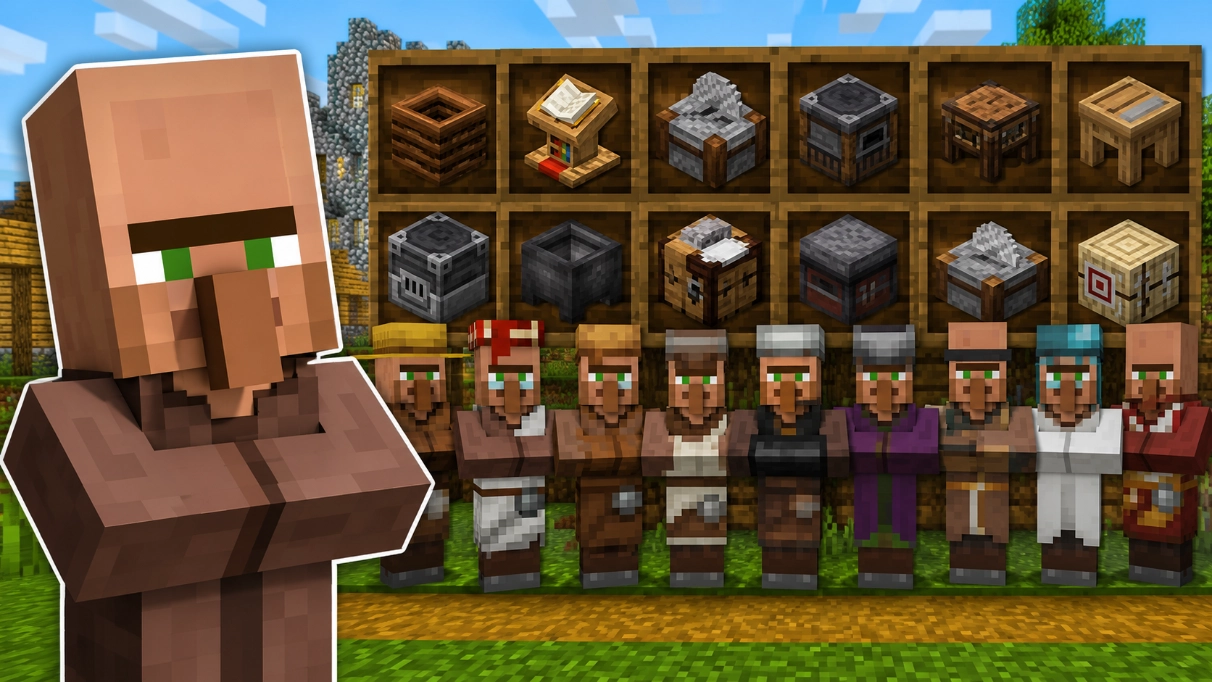
Villager Trades at a Glance
| Profession | Job block | Standout trades |
|---|---|---|
| Librarian | Lectern | Enchanted books (Mending!), bookshelves, lanterns |
| Cleric | Brewing Stand | Ender pearls, bottles o’ enchanting, redstone, glowstone, lapis |
| Armorer | Blast Furnace | Enchanted diamond armor, bells |
| Toolsmith | Smithing Table | Enchanted diamond tools, bells |
| Weaponsmith | Grindstone | Enchanted diamond sword and axe, bells |
| Farmer | Composter | Golden carrots, bread, cake, glistering melon |
| Fisherman | Barrel | Enchanted fishing rod, cooked cod, campfires, boats |
| Fletcher | Fletching Table | Arrows, bows, crossbows, tipped arrows |
| Shepherd | Loom | Wool, dyed wool, beds, banners, paintings |
| Cartographer | Cartography Table | Ocean and woodland explorer maps |
| Mason | Stonecutter | Terracotta, quartz, polished stone |
| Leatherworker | Cauldron | Leather horse armor, saddle, dyed leather armor |
| Butcher | Smoker | Cooked meat, rabbit stew, sweet berries |
How Villager Trades Work
Before the profession-by-profession breakdown, five mechanics decide how good your trades get:
- Leveling. Every villager starts as a novice and ranks up through apprentice, journeyman, expert, and master as you trade with it. Each rank unlocks up to two new trades from that profession’s pool, and the best deals (enchanted diamond gear, golden carrots, tipped arrows) sit at expert and master, so a fully leveled villager is worth far more than a fresh one.
- Locking. The moment you make your first trade with a villager, its profession and trade list are locked forever. Before that first trade you can break its job block, let it go unemployed, and replace the block to reroll the offers, this is how you fish for a specific enchanted book.
- Restocking. Villagers restock their trades up to twice a day, but only after walking to their job block and working at it. No reachable block, or you standing too far away for the village to load, means no restock.
- Price fluctuation. Spamming one trade makes the villager raise that item’s price (demand-based inflation); wait a while and it drops back. Discounts push prices the other way.
- Trading heals villagers. A neat bonus: trading with a hurt villager restores some of its health, so you can save one that a zombie or husk damaged just by buying something.
You assign a profession by placing the matching job site block next to an unemployed villager, the full block-to-profession list is in our villager jobs guide.
Every Profession’s Trades in Detail
Librarian (Lectern)

The best profession in the game. Librarians buy paper for emeralds and sell enchanted books, including treasure enchantments like Mending that an enchanting table can never give you. Books are pricey at base (14 emeralds plus the enchantment’s experience cost, so roughly 19 to 33), but discounts make them trivial. They also sell bookshelves (9 emeralds each), clocks, compasses, glass, lanterns, and red and yellow candles at master level. Librarians no longer sell name tags (removed in Java 26.1 and Bedrock 26.10); the Wandering Trader does now. Reroll the lectern before your first trade until you land the book you want.
Cleric (Brewing Stand)

The magic shop. Clerics buy rotten flesh (great for dumping zombie loot) and sell redstone (2 for 1 emerald), lapis lazuli, glowstone (4 emeralds), bottles o’ enchanting (3 emeralds) for portable XP, and, at the top, ender pearls (5 emeralds each), one of the only renewable pearl sources in the game.
Armorer (Blast Furnace)

Buys coal, iron, and even a lava bucket for emeralds, and sells armor that climbs to enchanted diamond armor, leggings and boots at expert, the helmet and chestplate at master, plus bells. See exactly what the armorer trades and how much each piece costs.
Toolsmith (Smithing Table)

Starts with junk stone tools but ranks up to enchanted diamond pickaxes, axes, shovels, and hoes (limited to a few per restock), plus bells. A full row of toolsmiths is unlimited diamond tools without a single mining trip.
Weaponsmith (Grindstone)

Buys iron and flint, sells bells, and at the top offers an enchanted diamond axe and, at master, an enchanted diamond sword, one of the strongest trades in the game for PvP and mob-clearing.
Farmer (Composter)

The classic early-game emerald engine. Farmers buy crops (wheat, carrots, potatoes, beetroot, pumpkins, melons) for emeralds, and with one zombie-cure discount a pumpkin or melon trade drops to 1 for 1 emerald. They sell bread, cookies, cake, suspicious stew, glistering melons, and, at master, golden carrots (3 for 3 emeralds).
Fisherman (Barrel)

Buys coal, string, and fish for emeralds, and sells cooked cod, campfires, an enchanted fishing rod, and the excellent boat for 1 emerald, one of the few trades that turns plain wood straight into emeralds.
Fletcher (Fletching Table)

The cheapest emerald farm in the game: it buys 32 sticks for 1 emerald, and sticks cost two planks. It also buys gravel, flint, and feathers, and sells arrows, bows, crossbows, an enchanted bow, and, at master, converts arrows into tipped arrows, letting you skip the End entirely for arrows of any effect.
Shepherd (Loom)

Buys wool and various dyes, and sells shears (great for a wool farm), dyed wool, carpets, beds, banners, and paintings. The go-to for builders who need colored blocks in bulk.
Cartographer (Cartography Table)

Buys paper and compasses and sells glass panes, item frames, banners, the globe banner pattern, and its headline items: ocean explorer maps (to ocean monuments) and woodland explorer maps (to woodland mansions), the easiest way to find those structures.
Mason / Stonemason (Stonecutter)

An underrated emerald machine. It buys 10 clay balls for 1 emerald and 20 stone for 1 emerald (nearly free with a discount), and sells bricks, terracotta and glazed terracotta, polished stone, and quartz blocks and pillars, a renewable source of decorative blocks you would otherwise grind for.
Leatherworker (Cauldron)

Buys leather and rabbit hide, sells dyed leather armor in random colors, leather horse armor, and, at master, a saddle, which outside of fishing and chests is one of the only renewable ways to get one.
Butcher (Smoker)

Buys raw meat, coal, and dried kelp blocks, and sells cooked meat, rabbit stew, and its best trade, sweet berries for emeralds. Pair a butcher with a large fox-powered berry farm for near-infinite emeralds.
Nitwit and the Wandering Trader

The green-coated Nitwit never takes a job and has no trades at all. The Wandering Trader is separate: it spawns randomly, never levels up, and only sells one way (emeralds for items) like saplings, flowers, coral blocks, and sand, useful for hard-to-find plants but never a core emerald source.
The Money Trades (Worth Building Around)
If you are planning a trading hall, prioritize these:
- Librarian enchanted books, especially Mending, the single best reason to build a librarian hall.
- Cleric ender pearls and bottles o’ enchanting, renewable teleporting and XP.
- The smith trio’s enchanted diamond gear, full enchanted diamond kit without mining, then disenchant on a grindstone if you want to reroll the enchantments.
Emerald-Income Trades (Sell to These)
To earn emeralds from what you already farm, lean on the Fletcher (sticks), Farmer (crops), Butcher (meat and berries), and Fisherman (fish). A few of these next to an automatic farm becomes a hands-off emerald income.
How to Pay Fewer Emeralds
Prices are not fixed. Two discounts stack and can drop a Mending book from dozens of emeralds to a single one:

- Cure a zombie villager. Curing gives that villager permanent, massive trade discounts. Trap one out of sunlight, throw a Splash Potion of Weakness, feed it a golden apple, and after it converts its prices collapse, the full method is in our cure a zombie villager guide.
- Hero of the Village. Win a raid and the resulting effect temporarily discounts every villager’s trades in the village.

Cured discounts are the real secret behind cheap Mending and one-emerald pumpkins.
Frequently Asked Questions
Villager trades are exchanges of emeralds for items, or items for emeralds, with professional villagers. Each of the 13 professions has its own pool of trades that unlock as the villager levels up from novice to master.
The Librarian is usually the most valuable because it sells enchanted books like Mending. The Cleric (ender pearls, bottles o’ enchanting) and the smiths (enchanted diamond gear) are close behind.
Trade with a villager to give it experience. It ranks up through apprentice, journeyman, expert, and master, and each rank unlocks up to two new trades from its profession’s pool.
Villagers only restock after working at their job site block, up to twice a day. If it cannot reach its block, or you are too far away for it to load, it never refreshes.
Cure a zombie villager for permanent discounts, or get the Hero of the Village effect by winning a raid. Both lower emerald costs, and curing can make Mending books cost as little as one emerald.
Only before you trade with it. Break its job site block to make it unemployed, then replace the block to reroll the offers. Once you trade even once, its trades are locked permanently.
There are 13 professions that trade, plus the jobless Nitwit and unemployed villagers, which do not trade at all. The Wandering Trader is a separate wandering mob with its own fixed trades.
Villager trades turn a village into an endless shop for emeralds: books and gear from the librarian and smiths, magic items from the cleric, decorative blocks from the mason, and easy emeralds from the farmer and fletcher. Level your villagers to master, cure a few for discounts, and you will never need to mine, farm, or grind for the game’s best items again.