The best villager trade prices, measured strictly by materials-per-emerald, are the Fletcher’s 32 sticks for 1 emerald, the Mason’s 10 clay balls for 1 emerald, and the Farmer’s 26 potatoes for 1 emerald, while on the sell side the Cleric’s 3-emerald Bottle o’ Enchanting and the Farmer’s 1-emerald loaf of bread (6 at a time) return the most value per emerald spent.
I keep a running trading hall on my own survival world just to track this stuff, and the honest answer is that “best trades” lists usually only tell you which trades to make, not what things actually cost. This is the price sheet: exact buy-side ratios (what you hand over per emerald) and sell-side prices (what you pay per item), across all 13 professions, plus the worst deals in the game so you know where your emeralds disappear for nothing.
Everything below is confirmed on the current 2026 version of Minecraft (26.3), where villager trading works identically on Java and Bedrock.
Quick Answer
- Cheapest buy-side trades: Fletcher (32 sticks), Mason (10 clay balls), Farmer (26 potatoes or 20 wheat), and Cleric (32 rotten flesh) all convert junk materials into emeralds at Novice level.
- Best sell-side value: the Cleric’s 3-emerald Bottle o’ Enchanting and the Farmer’s 1-emerald bread (6 loaves) return the most usable value for the fewest emeralds.
- Worst sell-side value: Master-tier enchanted diamond gear from the Weaponsmith and Toolsmith, which can cost 13 to 32 emeralds depending on the random enchantment rolled.
- Prices aren’t fixed: every purchase nudges a trade’s price up (demand), and curing a zombie villager or triggering Hero of the Village both push prices back down.
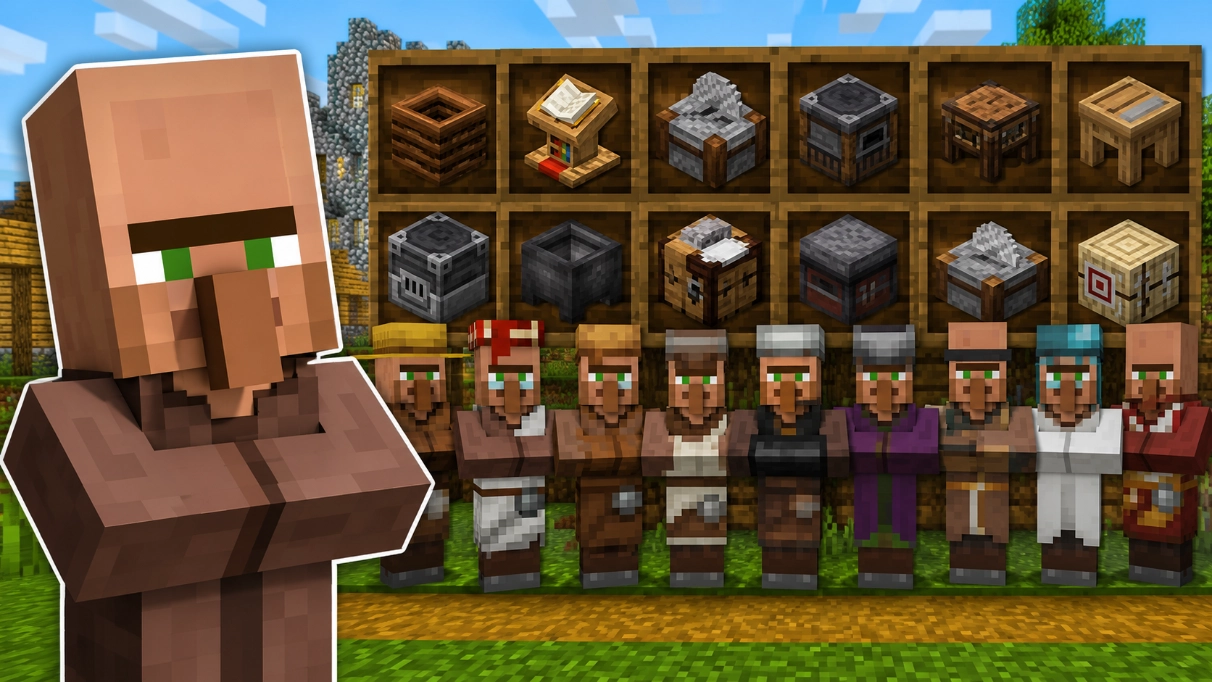
- Job site blocks matter: an unemployed villager becomes whatever profession matches the nearby workstation, so you can farm specific cheap trades by placing the right block.
Villager Trade Prices at a Glance
This table lists each profession’s cheapest Novice-level buy trade (what you hand the villager to get 1 emerald) and one notable sell trade (what you pay in emeralds to get an item), pulled from the Minecraft Wiki’s trading data.
| Profession | Job Site Block | Cheapest Buy Trade | Notable Sell Trade |
|---|---|---|---|
| Fletcher | Fletching Table | 32 sticks -> 1 emerald | 1 emerald -> 16 arrows |
| Mason | Stonecutter | 10 clay balls -> 1 emerald | 1 emerald -> 4 chiseled stone bricks |
| Cleric | Brewing Stand | 32 rotten flesh -> 1 emerald | 3 emeralds -> Bottle o’ Enchanting |
| Farmer | Composter | 26 potatoes / 20 wheat / 22 carrots -> 1 emerald | 1 emerald -> 6 bread |
| Leatherworker | Cauldron | 6 leather -> 1 emerald | 3 emeralds -> leather pants |
| Armorer | Blast Furnace | 15 coal -> 1 emerald | 4 emeralds -> iron boots |
| Weaponsmith | Grindstone | 15 coal -> 1 emerald | 3 emeralds -> iron axe |
| Toolsmith | Smithing Table | 15 coal -> 1 emerald | 1 emerald -> stone pickaxe |
| Fisherman | Barrel | 20 string / 10 coal -> 1 emerald | 3 emeralds -> bucket of cod |
| Butcher | Smoker | 14 raw chicken -> 1 emerald | 1 emerald -> 8 cooked chicken |
| Shepherd | Loom | 18 wool (one color) -> 1 emerald | 2 emeralds -> shears |
| Cartographer | Cartography Table | 24 paper -> 1 emerald | 7 emeralds -> empty map |
| Librarian | Lectern | 24 paper -> 1 emerald | 9 emeralds -> bookshelf |
Want the full breakdown of every level for every profession? Our Minecraft Villager Trades guide goes deeper on each one.
Best Buy-Side Prices (Cheapest Ways to Get Emeralds)
These are the trades where you’re handing over the least valuable materials for the most emeralds.
Fletcher – 32 Sticks per Emerald

The Fletcher’s Novice trade wants 32 sticks for 1 emerald. Sticks craft from planks two-for-one, so this is effectively free wood turned into currency, and it restocks in batches of 16 uses before the villager needs to sleep to refresh stock. It’s the single cheapest raw-material-to-emerald conversion in the game.
Farmer – Crop Trades by Type
Farmers buy four different crops at Novice level, and the ratios aren’t equal: 20 wheat, 26 potatoes, 22 carrots, or 15 beetroot, all for 1 emerald.
Beetroot is the best ratio per farmland tile since it needs the fewest items, but wheat is usually the easiest to mass-produce with a bread farm feeding a Farmer villager directly. Our Best Farmer Villager Trades in Minecraft guide covers which crop farm pairs best with which Farmer trade.
Mason – Clay, Stone, and Stone Variants
The Mason’s actual cheapest trade is 10 clay balls for 1 emerald at Novice level, not stone. Stone doesn’t show up until Apprentice, where it’s 20 stone for 1 emerald, still an excellent ratio since stone is essentially unlimited underground. Both trades make the Mason one of the best villagers to set up near any strip-mining operation.
Cleric – Rotten Flesh Dump

The Cleric’s Novice trade takes 32 rotten flesh for 1 emerald, turning the single most useless drop in the game (from every zombie, husk, drowned, and zombie villager you kill) into currency. If you’re running a zombie-based mob farm for XP anyway, this trade alone can fund a trading hall.
Best Sell-Side Prices (Most Value Per Emerald Spent)
These are the trades where your emeralds go the furthest.
Librarian – Enchanted Books and Mending
Librarian enchanted books cost 5 to 64 emeralds plus a book, with the price randomized to the specific enchantment rolled when the trade unlocks. That’s a wide range, but the trade is the only reliable way to buy a specific enchantment on demand, including Mending, which doesn’t drop from anything else in Survival.
Our Best Librarian Villager Trades in Minecraft guide covers how to re-roll a librarian’s trades until Mending shows up.
Cleric – Bottles o’ Enchanting and Ender Pearls

At Master level, a Cleric sells a Bottle o’ Enchanting for just 3 emeralds, cheaper than farming XP most other ways this early into a world. At Expert level, the same villager sells an Ender Pearl for 5 emeralds, which is a legitimate way to stock up for Eyes of Ender before you’ve found a stronghold or gone hunting Endermen.
Cartographer – Explorer Maps
Cartographers sell an empty map for 7 emeralds at Novice level, but the real value is in the biome-specific explorer maps at higher tiers, like the Ocean Monument Map (13 emeralds plus a compass) or the Woodland Mansion Map (14 emeralds plus a compass). Paying 13-14 emeralds to skip hours of exploring for a monument or mansion is one of the best emerald-to-time trades in the game.
The Worst-Value Trades (Where Your Emeralds Don’t Go Far)
Not every trade is worth making, and the game is upfront about it once you compare the numbers.
The single worst sell-side value is Master-level enchanted gear from the Weaponsmith and Toolsmith. An enchanted diamond sword costs 13 to 27 emeralds, and an enchanted diamond pickaxe costs 18 to 32 emeralds, both with a randomized enchantment you don’t get to choose.
Compare that to the Farmer’s 1 emerald for 6 loaves of bread or the Fletcher’s 1 emerald for 16 arrows, and it’s clear those trades exist for players who are emerald-rich and time-poor, not as an efficient way to gear up.
On the buy side, the Cleric’s Expert trade wanting 4 Turtle Scutes for 1 emerald looks fine on paper, but turtle scutes only come from baby turtles growing up, which takes real farming setup to produce in bulk. A “good ratio” trade is only good if the material is actually easy to get.
One more thing worth knowing: every trade in the game has a hidden price multiplier that controls how fast its price rises with demand. Most basic trades use a multiplier of 0.05, but higher-value trades like enchanted books, armor, and tools use a steeper 0.2 multiplier.
That means buying out a stack of enchanted books in one visit inflates the price much faster than buying out a stack of arrows.
Trades Most Players Miss (and a Couple to Skip)
Beyond the raw ratios, a few trades are worth flagging on their own because the value isn’t obvious from the numbers alone.
The Fisherman’s coal trade, 10 coal for 1 emerald, is the best coal-to-emerald rate of any profession in the game (everyone else selling coal wants 15). If you’re clearing out a coal-heavy mine and deciding which villager to dump it on, the Fisherman wins every time.
At Master level, the Fisherman also drops to a single boat for 1 emerald, and since boats only cost 5 planks each with no shovel requirement, that’s one of the cheapest renewable emerald loops in a wood-rich biome.
The Librarian is the trade most players undervalue on price alone, because the ratio (paper for emeralds) looks unremarkable. What makes the profession worth building around is that it sells enchanted books at Novice level, not just at Master, and the enchantment rolled is random and equally weighted across the whole pool. That means a fresh, unleveled Librarian can already offer Mending, Protection IV, or Sharpness V.
If the current offer isn’t what you want, breaking the lectern and placing a new one rerolls the villager’s trade pool entirely (this works because breaking the job site un-employs the villager, and placing a fresh one re-employs them with a new random trade set). Repeating that cycle until the enchantment you want shows up, sometimes called “lectern cycling,” is a free way to fish for a specific book without touching an enchanting table.
On the skip side, the Leatherworker’s buy-side ratio (6 leather for 1 emerald) is fine, but almost everything the profession sells is now craftable or replaceable another way, so it’s not worth leveling up just for the sell trades.
The same goes for a Butcher or Fisherman’s early raw-food trades before they level up. They’re not bad ratios, they’re just outclassed by trades from other professions that cost about the same and return more.
How Prices Actually Change
The numbers above are starting prices. They move.
Demand-Based Price Increases
Every time you buy a trade, its price ticks up slightly (this is the “demand” mechanic), and that price resets only when the trade restocks. Buying everything a villager has in stock in one visit is usually a bad idea if you plan to come back for more of the same trade later that day.
Zombie-Curing Discount

Curing a zombie villager with a Splash Potion of Weakness and a golden apple gives that villager a permanent discount on all of its trades once it recovers.
The discount stacks if you zombify and cure the same villager more than once, which is why “professional” trading halls are usually built around villagers that have been cured multiple times. Our How to Cure a Zombie Villager guide walks through the process.
Hero of the Village Discount
Successfully defending a village from a raid gives nearby villagers the Hero of the Village status effect, which temporarily discounts their trade prices. The discount is stronger at higher raid difficulty and fades out over the days the effect lasts, so it’s worth stocking up on emeralds before triggering a raid on purpose.
Restocking Trades
Villagers refresh their trade stock (and reset demand-based price increases) when they sleep in a claimed bed at night, up to twice per in-game day. If a villager isn’t restocking, our How to Restock Villager Trades in Minecraft guide covers the common reasons why (usually a missing bed or a blocked workstation).
The Fletcher’s Novice trade, 32 sticks for 1 emerald, is the cheapest buy-side conversion in the game since sticks cost almost nothing to craft in bulk.
The Cleric’s Master-level Bottle o’ Enchanting, at 3 emeralds each, and the Farmer’s 1 emerald for 6 bread are the best value sell-side trades for early and mid-game players.
Yes. Each purchase raises that trade’s price slightly through a demand mechanic, and the increase resets when the trade restocks. Higher-value trades like enchanted gear use a steeper price multiplier, so they get expensive faster.
Yes. Curing a zombie villager applies a permanent trade discount to that villager, and the discount stacks if the same villager is zombified and cured again.
Master-level enchanted diamond tools and weapons from the Toolsmith and Weaponsmith are the most expensive, costing up to 27 to 32 emeralds depending on the randomly rolled enchantment.
No. Since the villager trading rework, the material ratios and emerald costs are the same on both editions. The main differences are small probability variations in which trades a villager offers.
Villager trading rewards knowing the numbers, not just the profession. Set up a Fletcher and a Farmer for cheap emeralds, keep a cured Cleric around for Bottles o’ Enchanting, and skip the Master-tier enchanted gear unless you’re genuinely emerald-rich.
Sources
Prices and mechanics in this guide were checked against the Minecraft Wiki (version 26.2) and cross-referenced against these videos: