Iron is the backbone of Minecraft. From your first pickaxe to your last bucket of lava, almost every stage of the game requires iron in some form. Buckets, hoppers, anvils, armor, tools, rails, minecarts, pistons – the demand for iron never really stops.
Whether you’re trying to find iron in the first hour of a new world or scaling up to hundreds of ingots per hour in the late game, this guide covers every method ranked from fastest to slowest for Java Edition 1.21+ and Bedrock Edition.
What You Can Do With Iron (Quick Reference)
Iron ingots are one of the most versatile resources in the game. Here’s a snapshot of what you’ll be spending it on:
| Use | Iron Required |
|---|---|
| Full iron armor | 24 ingots |
| Full set of iron tools | 15 ingots |
| Hopper | 5 ingots |
| Anvil | 31 ingots |
| Cauldron | 7 ingots |
| Bucket | 3 ingots |
| Compass | 4 ingots |
| Rail (16 rails) | 6 ingots + 1 stick |
Once you start building automated farms with hoppers, you’ll realize you can never really have enough iron. Let’s fix that.
Method 1: Iron Golem Farm (Best Method – Up to 400 Ingots/Hour)
Best for: Mid-to-late game, maximum iron output, passive production

An iron golem farm is by far the best way to get iron in Minecraft. Iron golems drop 3–5 iron ingots per kill, and a properly built farm can produce between 240 and 400 ingots per hour – completely passively while you do other things.
How Iron Golem Farms Work
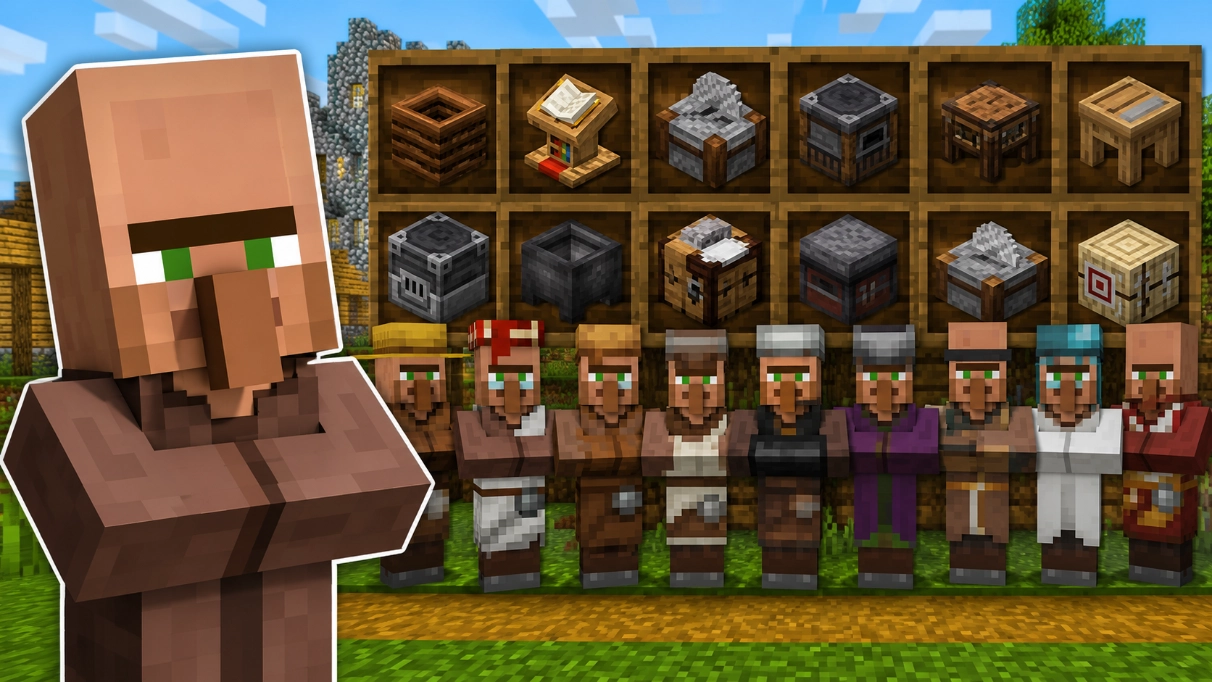
Iron golems are spawned naturally by villages. The farm works by setting up a controlled village environment – beds, villagers, and a threat source – that tricks the game into continuously spawning golems, which are then automatically killed and their drops collected.
There are two trigger methods:
Panicking (recommended): When 3 or more villagers see a threatening mob (like a zombie), they panic and attempt to spawn an iron golem. This is the most efficient trigger because it requires only 3 villagers and is easy to automate with a caged zombie that can’t harm them.
Gossiping: When 5 or more villagers gossip after trading, curing, or other interactions, they can also trigger golem spawns. Less reliable and requires more villagers than the panic method.
Iron Golem Farm Rates (Wiki-Verified)
The theoretical maximum output is 404 ingots per hour, achieved when:
- All 512 possible spawn blocks are active
- Golems are transported and killed fast enough (lava blade kill method)
- The golem cap resets quickly via a drop chute
In practice, most well-built survival farms produce 240–400 ingots per hour, depending on the design.
Java Edition Requirements
For the golem to spawn, all of the following must be true:
- Villagers have slept for the last 20 minutes
- At least 3 villagers are within a 10-block radius
- No existing iron golem is within 16 blocks (within the last 30 seconds)
- A valid solid block exists for the golem to spawn on
Tip: Use the panic method with a caged zombie rather than gossiping. It only needs 3 villagers, the zombie won’t despawn if you name-tag it or put it in a boat, and it doesn’t require player interaction.
Bedrock Edition Requirements
Bedrock farms need a larger setup:
- At least 20 beds in the village
- At least 10 villagers
- At least 75% of villagers worked at a workstation the previous in-game day
- All villagers are linked to a bed
- The player must be within simulation distance
- The spawn cap: 1 golem per 10 villagers (so 20 villagers = up to 2 golems active at once)
The Bedrock has a 1 in 700 chance of a spawn attempt per game tick, averaging one attempt every 35 seconds.
Best Kill Method
Use a lava blade – lava suspended over a collisionless block, such as a sign or open fence gate. Golems walk into it and die, dropping their iron into a hopper below, feeding into a chest. It’s fast, reliable, and requires no player input.
Trident killers can kill even faster if tridents are enchanted with Impaling V and the golems are kept in water, and they apply Looting if you hold a Looting sword when the trident is thrown.
Do You Need to Drain an Ocean Monument?
No-iron golem farms don’t involve the ocean at all. They’re built anywhere, most commonly near or inside your base.
Increasing Spawn Rate
On Java Edition, you can use a Nether portal trick: golems teleported to the Nether instantly reset the spawn cap, allowing new golems to spawn faster. A more reliable alternative is building a drop chute that clears the cap by moving golems away from the village detection radius immediately after spawning.
Method 2: Branch Mining at the Correct Y-Level
Best for: Early-to-mid game, before you have a golem farm set up
Mining iron ore directly is the most accessible method and your go-to option before you have the resources to build a golem farm. You only need a stone pickaxe or higher to mine it – though you’ll want at least an iron pickaxe for speed once you have a few ingots to spare. The key is knowing exactly where iron spawns so you’re not wasting time in the wrong place.
Where Iron Ore Spawns (Wiki-Verified)
Iron ore generates in three separate batches per chunk, each with different Y-level ranges:
Batch 1 (surface layer):
- Attempts 90 times per chunk
- Blob size: 0–13 (Java) or 0–16 (Bedrock)
- Range: Y=80 to Y=384
- Most common around Y=232
- Becomes less common toward either end
Batch 2 (underground layer):
- Attempts 10 times per chunk
- Same blob sizes
- Range: Y=?24 to Y=56
- Most common around Y=16
Batch 3 (buried deep layer):
- A separate, smaller set of clusters
- Concentrated in the deeper underground zones
- Produces the deepslate iron ore variant below Y=0
Best Y-Level for Mining Iron
For maximum total iron:
- Y=16 is the sweet spot for the deep underground batch – low enough to hit dense deposits, high enough to avoid the lava lakes that become more common below Y=0
- Y=232 in mountains/high terrain is actually the single highest concentration point in the game, but this requires you to be in a mountain or extreme hills biome where the surface terrain reaches those heights
For practical early game play:
- Mine at Y=15 to Y=20 – this is below the transition to deepslate (which is slower to mine) while still being in the sweet spot of Batch 2
Fortune III Is Essential

Unlike netherite, iron ore is affected by Fortune. Here’s exactly what you get:
| Fortune Level | Raw Iron per Ore |
|---|---|
| None | 1 |
| Fortune I | 1–2 (avg 1.33) |
| Fortune II | 1–3 (avg 1.67) |
| Fortune III | 1–4 (avg 2.2) |
Fortune III nearly doubles your iron yield per ore block. Always use a Fortune III pickaxe once you have one – ideally on a diamond pickaxe, since diamond tools last long enough to make the Fortune enchantment worth investing in.
Branch Mining Setup

- Dig down to Y=15
- Create a central hallway (1 wide, 2 tall)
- Branch off every 3 blocks with perpendicular tunnels, each 30–40 blocks long
- Use Efficiency V and Haste II (from a Beacon) for maximum speed through stone and deepslate
Method 3: Cave Mining
Best for: Early game, players who prefer exploration over repetitive tunneling

Caves in Minecraft 1.18+ are enormous, and iron ore is exposed on the walls in massive quantities, especially in the Dripstone Cave biome, where iron generates more frequently than usual. For new players wondering how to find iron in Minecraft without branch mining, exploring a large cave system is the fastest answer – you can often collect several stacks of raw iron just by following the tunnels.
Tips for Cave Mining
- Bring plenty of torches or use Night Vision potions
- Dripstone Caves have boosted iron generation – if you find one, prioritize it
- Ravines are also excellent – iron veins are exposed along the walls without needing to mine them out
- Watch for deepslate iron ore below Y=0, which takes slightly longer to mine but is still worth collecting
Method 4: Loot Chests
Best for: Early game iron when you haven’t started mining yet
Iron ingots and iron equipment appear in many structure chests across the Overworld and Nether. Here are the best sources:
| Structure | What You Get |
|---|---|
| Village chests (weaponsmith, toolsmith, armorer) | Iron ingots, iron tools, iron armor |
| Mineshaft chests | Raw iron, iron picks |
| Stronghold chests | Iron ingots |
| Dungeon chests | Iron ingots |
| Shipwreck chests | Iron ingots, iron tools |
| Bastion Remnant chests | Iron ingots, iron blocks |
Village smiths are your best early-game source. Weaponsmith, toolsmith, and armorer chests all have a high chance of containing iron ingots or iron gear you can smelt down.
Bastion Remnants can contain entire iron blocks in their treasure rooms, which equals 9 ingots per block – an enormous early Nether windfall.
Method 5: Killing Iron Golems in Villages
Best for: Desperate early game iron when nothing else is available

Naturally spawning iron golems in villages drop 3–5 iron ingots when killed. This is not a sustainable method and will make the villagers hostile, but in a pinch – especially on day one of a new world – finding and killing a village’s iron golem gives you a quick burst of iron without needing to mine at all.
Note: Killing a village’s iron golem will cause nearby villagers to become hostile toward you temporarily. Wear a carved pumpkin on your head to avoid this (golems won’t attack players wearing one).
Method 6: Zombie and Drowned Drops
Best for: Very early game, supplementary iron
Zombies have a small chance (~0.83% on Normal difficulty) to drop an iron ingot on death, and this increases slightly with the Looting enchantment. Drowned have a similar drop chance and can also drop iron ingots.
This isn’t reliable enough to be a primary iron source, but running a zombie or drowned XP farm alongside your iron golem farm means you’ll passively accumulate extra ingots over time.
How to Smelt Iron Fast
Once you have raw iron, smelting speed matters. Here are your options:
| Method | Smelt Speed | Notes |
|---|---|---|
| Regular Furnace | 1 item per 10 seconds | Slowest |
| Blast Furnace | 1 item per 5 seconds | 2x faster, use this for ores |
| Multiple Blast Furnaces | Scales linearly | Run 8–10 in parallel for bulk smelting |
Always use a Blast Furnace for iron – it smelts ores twice as fast as a regular furnace. For fuel, dried kelp blocks are the most efficient fuel source (smelts 20 items per block), and lava buckets are a single-use but extremely efficient option (smelts 100 items per bucket).
Iron Methods Ranked: Quick Reference
| Method | Output | Game Stage | Setup Effort |
|---|---|---|---|
| Iron Golem Farm | 240–400 ingots/hr | Mid-late game | Medium-Hard |
| Branch Mining (Y=15, Fortune III) | Variable, high | Any stage | Easy |
| Cave/Dripstone Cave Mining | Variable | Early-mid game | Very easy |
| Loot Chests | One-time bursts | Early game | Very easy |
| Killing Village Golems | 3–5 ingots | Early game | Very easy |
| Zombie/Drowned Drops | Very low | Any stage | Passive |
Pro Tips for Getting Iron Faster
1. Always use Fortune III. It nearly doubles your raw iron output per ore. This is the single biggest multiplier for mining iron directly and should be your first goal when enchanting.
2. Build the golem farm as soon as possible. Even a basic Bedrock Edition golem farm with 10 villagers and 20 beds will produce enough iron to cover all your needs passively. A single hour of uptime gives you multiple stacks of iron – enough for hoppers, armor, and tools combined – and the investment of materials pays off extremely quickly.
3. Mine in Dripstone Caves. Iron is generated at a higher rate in this biome. If you find one, cave mine it before you switch to branch mining.
4. Don’t smelt in regular furnaces. A Blast Furnace cuts your smelting time in half. Build one as soon as you have any iron – it pays for itself instantly.
5. Loot Bastions early. Bastion treasure rooms can contain iron blocks (9 ingots each), sometimes multiple at once. Looting a Bastion in your first Nether trip can give you more iron than an hour of mining.
6. Pair your golem farm with a Looting sword. Some kill methods (trident killers, manual killing) let you apply Looting III to golem drops, pushing the maximum ingots per kill from 5 to 8. This significantly boosts your hourly rate.
Frequently Asked Questions
What is the best Y-level to mine iron in Minecraft?
For most players, Y=15 to Y=16 is the most practical mining level, hitting the peak of the underground iron batch while staying above the worst lava concentrations. If you’re in a mountain biome with terrain above Y=200, mining near Y=232 hits the single highest iron density point in the game.
Does Fortune work on iron ore?
Yes. Fortune directly increases the amount of raw iron dropped per ore block. Fortune III gives 1–4 raw iron per ore (average 2.2), compared to 1 raw iron without it, nearly doubling your yield.
How many ingots does an iron golem drop?
An iron golem drops 3–5 iron ingots per kill. With Looting III applied, this increases to up to 8 ingots per kill. At a farm output rate of one golem every ~35 seconds, this adds up very quickly.
Can you get iron without mining?
Yes. Iron can be obtained from village chests, Bastion Remnant chests, killing iron golems, zombie drops, drowned drops, and trading with villagers. None of these are as consistent as a golem farm or branch mining, but they work especially well in the early game.
What biome has the most iron ore?
Dripstone Caves have an elevated iron ore generation rate compared to standard cave biomes. Mountain and extreme hills biomes also have very high iron density at the Y=232 surface range. For underground mining, the biome matters less than the Y-level.
Is an iron golem farm better than mining?
Yes, by a large margin in the late game. A mid-tier iron golem farm produces 240–400 ingots per hour passively with no player input, while branch mining requires constant active play and still produces less per hour. Build the golem farm as soon as you can.
Related mining guides: best Y level for ancient debris, best Y level for coal, best Y level for lapis lazuli.