The fastest way to stop scraping by in a new survival world is to build a handful of simple farms that hand you food, iron, and enchanting materials on repeat. This guide covers the six early-game farms worth building first, what each one gives you, and the order to build them so your world snowballs from day one.
Everything here is confirmed in the current 2026 version of Minecraft (26.3) and works in both Java and Bedrock unless noted.
Quick answer: the best early-game farms are a food farm (chicken cooker or cow farm), an auto crop farm, a mini iron farm, a sugarcane/bamboo farm, a wool farm, and a mob or XP farm. Build the food and crop farms first so you never starve, then the iron farm, since iron unlocks almost everything else.
The Six Farms at a Glance
| Farm | What it gives you | Build difficulty |
|---|---|---|
| Food (chicken cooker/cow) | Endless cooked meat, plus leather from cows | Easy |
| Auto crop (villager) | Wheat, carrots, or potatoes with no manual farming | Easy |
| Mini iron farm | Hundreds of iron per hour | Medium (needs villagers) |
| Sugarcane/bamboo | Paper for books, and scaffolding | Easy |
| Wool | Any color of wool for beds and building | Easy |
| Mob / XP farm | Experience, bones, string, gunpowder, arrows | Medium |
1. A Food Farm (Build This First)

Nothing else matters if you starve, so a food farm comes first. You have two great options:
- Chicken cooker. A fully automatic chicken farm uses a dispenser or lava to cook chickens the moment they grow up, dropping cooked chicken straight into a chest. Seed it with a handful of eggs, and the adults lay more eggs to keep the cycle going. It is the most hands-off food source in the game and eliminates the need for large crop farms.
- Cow farm. A fenced pen with two breeding cows gives you steak plus a steady supply of leather, which you will need constantly for books and bookshelves. Feed the pair wheat, let babies grow, and harvest the excess with a Looting sword. It is the best early source of both food and leather, covered in full in our best way to get leather guide.
Most players end up building both, since chickens handle raw food volume and cows cover leather.
2. An Auto Crop Farm

Once food is handled, a villager-powered crop farm removes farming from your to-do list entirely. You drop a farmer villager into a small enclosure planted with carrots, potatoes, or beetroot (not wheat, which the villager will not replant reliably), give him a composter, and he harvests and replants automatically. The crops drop through trapdoors into a hopper and chest below.
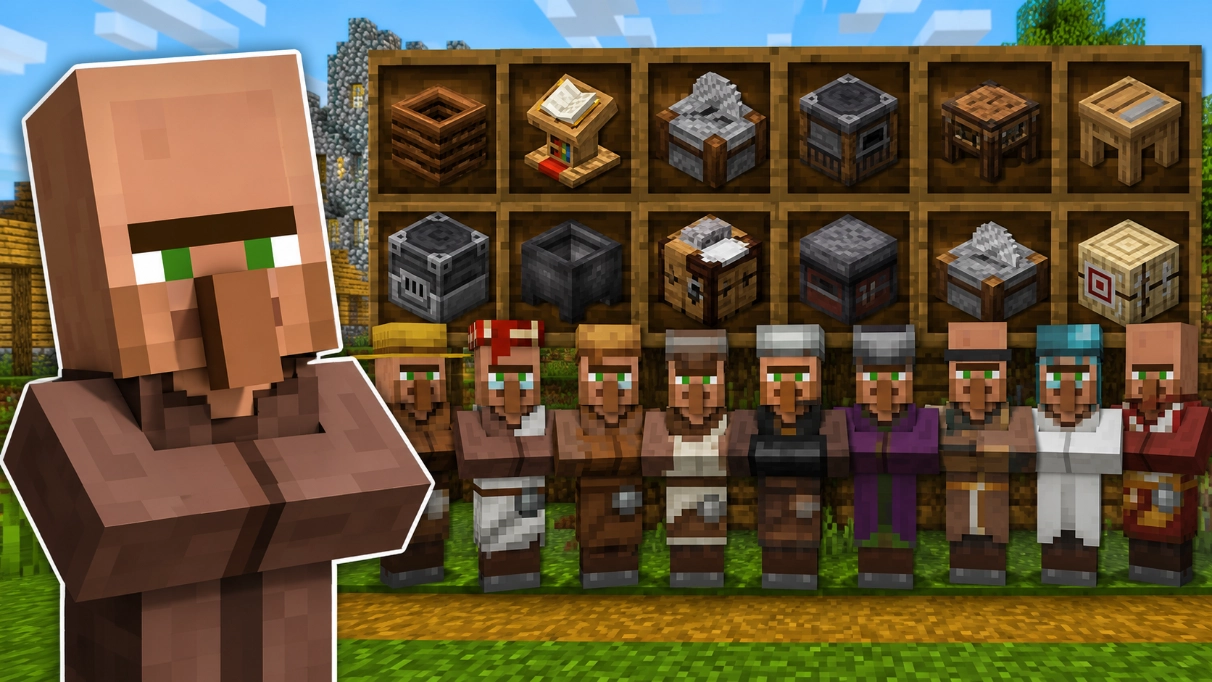
This gives you a passive stack of food and, just as importantly, a renewable supply of carrots and potatoes to breed and feed other villagers. If you are new to moving villagers around, our villager jobs guide explains how professions and job site blocks work.
3. A Mini Iron Farm

Iron is the backbone of every mid-game project, and mining for it by hand is slow, so a mini iron farm is the highest-value build on this list. The compact designs use three villagers and a zombie: the villagers get scared by the nearby zombie, which triggers iron golems to spawn, and the golems are pushed by water into lava or a killing floor, dropping iron into a hopper.
A small iron farm produces several hundred iron per hour, which is more than enough to armor up, build tools, hoppers, rails, and redstone, and still have iron to trade. Because it needs villagers, build a villager breeder first if you do not already have spare villagers. You can even combine the iron farm with a villager trading hall so one structure gives you iron and enchanted-book trades at once. Our dedicated iron farm guide has a full block-by-block build.
4. A Sugarcane or Bamboo Farm

A simple sugarcane farm turns into paper, and paper turns into books, which means bookshelves for enchanting and emeralds from selling paper to a librarian. An observer watches the top of the cane, a piston breaks it when it grows, and the cane washes into a hopper. It is a low-cost, low-maintenance build that pays off the moment you set up an enchanting table.
The same design grows bamboo, which you can turn into scaffolding for building up safely or feed into a furnace as fuel. Many players alternate the two. Pair this with the cow farm and you have an automatic book-making machine: leather from cows, paper from cane.
5. A Wool Farm

A wool farm is a small, redstone-light build that gives you any color of wool on demand. You place a sheep on a grass block over a dispenser loaded with shears; an observer detects the sheep eating the grass and fires the shears, and the wool washes into a hopper. Dye a few sheep different colors and you have a rainbow of renewable wool.
Wool matters early because every bed needs three wool, and beds are how you set your spawn and skip the night. Beyond beds, wool is one of the best decoration and building blocks, and it muffles sound for sneaking through the deep dark later. Our how to make a bed guide covers the recipe.
6. A Mob or XP Farm

Finally, an experience farm gives you the levels you need for enchanting and gear repair. Early on, you have two easy options:
- Spawner farm. If you find a skeleton or zombie spawner in a cave, box it in, funnel the mobs into a one-hit killing spot, and you get a steady stream of XP plus bones (for bone meal), arrows, and string. Spawner farms are the easiest early XP because the spawner does the spawning for you.
- General mob or gunpowder farm. A dark spawning platform above your base collects the drops from natural mobs: gunpowder from creepers (for TNT and fireworks), string from spiders, and bones from skeletons. A creeper-focused design gives you gunpowder in bulk, useful for the gunpowder you need for rockets and TNT.
An AFK fishing spot is a third option that quietly hands you food, enchanted books, and XP with zero redstone.
The Order to Build Them
Build in this order so each farm supports the next:
- Food farm (chicken cooker or cow) so you never starve.
- Auto crop farm for passive food and villager-breeding crops.
- Villager breeder, then the mini iron farm, since iron unlocks tools, hoppers, and rails for every later build.
- Sugarcane/bamboo and wool farms for enchanting materials and beds.
- Mob/XP farm once you have iron gear to fight safely.
Follow that sequence, and within a few in-game days you will have unlimited food, iron, wool, paper, and XP, which is everything you need to move from surviving into building whatever you want.
Frequently Asked Questions
A food farm. A chicken cooker or a cow farm gives you unlimited cooked meat so you never starve, and a cow farm also supplies leather for books and bookshelves.
The mini iron farm gives the most, since iron is used in tools, hoppers, rails, buckets, and redstone. It needs villagers, so build a villager breeder first.
Most do not. Food, cow, wool, and sugarcane farms use little or no redstone. The auto crop farm uses a villager instead of redstone, and only the iron and mob farms get slightly more advanced.
Box in a skeleton or zombie spawner if you find one, or build a small mob farm over your base. Both give steady experience plus useful drops like bones, string, and arrows. AFK fishing also gives XP.
A sugarcane farm. Sugarcane crafts into paper, and paper plus leather makes books and bookshelves for enchanting. The same build design also works for bamboo.
Yes. A popular combo stacks a villager breeder, an iron farm, a trading hall, and villager crop farms into one structure so a single area gives you iron, trades, and food at the same time.
Start with food, add a crop farm, then race to an iron farm, and the rest of the game opens up. These six farms are cheap, mostly redstone-free, and turn a fragile new world into a self-sufficient base faster than almost anything else you can do early on.
Sources
Every farm in this guide was cross-checked against these video tutorials, with builds and rates confirmed on the Minecraft Wiki (tested on Minecraft 26.2):
- 5 Must-Have Starter Farms in 2026 (Minecraft 26.1+)
- 8 Must-Have Starter Farms for the Minecraft 26.1 Update
- Easiest Auto-Cooking Cow Farm (Minecraft 26.2)
- Auto Crop Farm – Wheat, Carrot, Potato (1.21+ Java)
- Easy Automatic Chicken Farm (1.21 / 26.1 / 26.2 / 26.3)
- Easiest Iron Farm in Minecraft 26.2 – Build It on Day 1
- New Best Sugarcane Farm, Minecraft 1.21/26.1 (10,000/h)
- Easy Automatic Bamboo Farm in Minecraft 1.21+
- The Easiest Wool Farm in Minecraft 1.21
- Easiest XP Farm in Minecraft 1.21, Perfect for Early Game