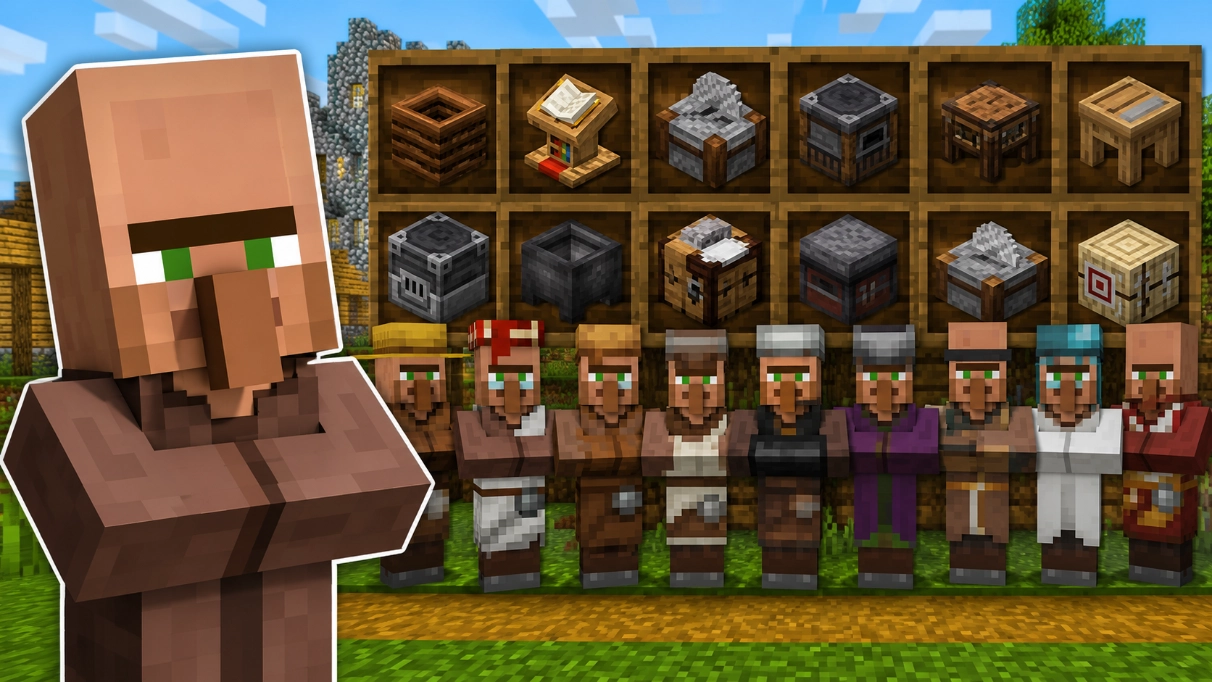
Villagers will not follow you, so relocating one to your base or trading hall takes a trick or two. This guide covers every reliable way to move a villager, from a quick boat ride to long-distance minecart and Nether routes, and which method to use for each situation.
Everything here is confirmed in the current 2026 version of Minecraft (26.3) and works in both Java and Bedrock.
Quick answer: the easiest way to move a villager a short distance is to push it into a boat and row it to your destination. For longer trips use a minecart on rails, and for hills attach a lead to the boat or lure the villager with its job site block.
Ways to Move a Villager at a Glance
| Method | Best for |
|---|---|
| Boat | Short, mostly flat trips |
| Minecart on rails | Long distances and rough terrain |
| Furnace minecart | Auto-pushing a villager down a track |
| Lure with a job block | Slow, no-materials moves nearby |
| Ice + boat | The fastest long-distance travel |
Method 1: Boat (Easiest)

Place a boat next to the villager and walk into the villager to push it into the boat. Then hop in and row, boats slide over land as well as water, so you can steer the villager wherever you want. This is the fastest setup for a short, mostly flat move.
The downside is hills: a boat struggles to climb. To go uphill, push the boat with a piston powered by a lever, or attach a lead to the boat and drag it up while you climb.
Method 2: Minecart on Rails (Long Distance)

For a long or bumpy trip, lay a rail track from the villager to your destination, place a minecart, and push the villager into it. Then push the cart along, adding powered rails every 20 to 30 blocks (each needs a redstone signal from a torch, lever, or button) to keep it moving on flat ground.
A hands-off upgrade is the furnace minecart: place one behind the villager’s minecart, fuel it with coal, and it pushes the villager all the way to the end of the track on its own.
Method 3: Lure With a Job Site Block

If you have no boat or rails, use the villager’s own workstation. Place its job site block a few blocks away and the villager paths straight to it. Break that block, place another further along, and it follows again.
Repeat, and you can walk a villager across your base one block at a time using two job blocks. Our Minecraft villager jobs guide lists which block each profession uses.
Method 4: Ice and Nether Shortcuts
For serious distance, blue or packed ice with a boat is the fastest travel in the game, lay a two-wide ice path and the boat flies along it.
You can also move a villager through the Nether: take it through a Nether portal, travel a short way, and build a return portal, since 1 block in the Nether covers 8 in the Overworld. These pair well with a full villager trading hall build.
Whatever method you use, keep the villager close so it does not despawn, and make sure it is a villager you actually want, since moving one is far more work than breeding a new one where you need it.
Frequently Asked Questions
The simplest way is to push it into a boat and row it to your destination. For long distances use a minecart on rails, and for hills attach a lead to the boat or lure the villager with its job site block.
Yes. Walk into the villager next to a placed boat to push it in, then get in the boat yourself and row it across land or water to move the villager.
Boats do not climb well, so push the boat up with a piston and a lever, attach a lead to the boat and drag it up, or switch to a minecart track with powered rails.
Use a minecart on rails with powered rails every 20 to 30 blocks, a furnace minecart to auto-push it, or an ice-boat path, which is the fastest option in the game.
Yes, indirectly. Place the villager’s job site block nearby and it will path to it, then break and replace the block further along to lure it step by step.
Villagers do not naturally despawn, but keep it loaded and nearby during the move, and avoid leaving it far behind, so you do not lose track of it.
Moving a villager is all about picking the right tool: a boat for a quick hop, a minecart or ice path for distance, and a job block to lure one with no materials at all. Choose the method that fits your terrain and your villager lands exactly where you want it.