A grindstone is the block you use to strip enchantments off an item and get some experience back, and to repair basic gear on the cheap. It is the opposite of an anvil: where an anvil keeps enchantments, a grindstone removes them. It is also dirt cheap to make.
This guide covers the recipe, what a grindstone does, when to use it instead of an anvil, and where to find one. Everything here is accurate for the latest 2026 version of Minecraft.
Quick answer: craft a grindstone from 2 sticks, 1 stone slab, and 2 wooden planks. Place a stick, the stone slab, and a stick across the top row, then a plank on each side of the middle row.
Grindstone at a Glance
| Detail | Value |
|---|---|
| Recipe | 2 sticks + 1 stone slab + 2 planks |
| Main use | Remove enchantments (refunds XP) and repair |
| Also found in | Village weaponsmiths and trail ruins |
| Villager job | Weaponsmith |
How to Craft a Grindstone

The recipe is quick and uses only early materials:
- Top row: stick, stone slab, stick
- Middle row: plank, empty, plank
That is 2 sticks, 1 stone slab, and 2 wooden planks (any wood works). Sticks come from planks, and a stone slab is made from smooth or regular stone, so you can build one almost as soon as you have a crafting table.
What a Grindstone Is Used For

A grindstone has two jobs, plus a bonus:
- Remove enchantments for XP. Put an enchanted item in a grindstone and it strips all enchantments except curses, and refunds some of the experience that went into them. This is the main reason to make one, since it lets you recycle unwanted enchanted gear (from villager trades, fishing, or loot) back into XP. Just set your expectations: the XP you get back is modest and scales with the enchantments removed, so it is a nice bonus, not a windfall or an XP farm.
- Repair items. Combine two of the same item in the grindstone to repair one, adding their durability together plus a small bonus. The catch: this removes any enchantments, so only use it on plain gear.
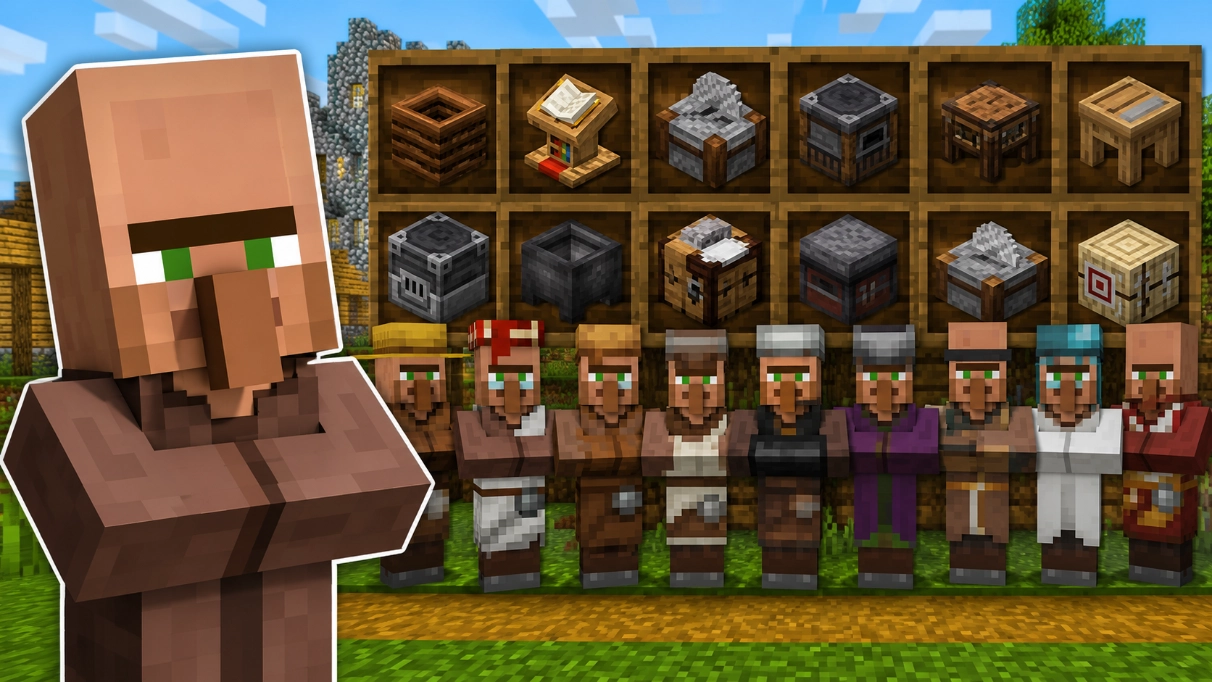
- Weaponsmith job block. Placing a grindstone near an unemployed villager turns them into a weaponsmith, which is how you set up weapon and enchanted-gear trades. See our Minecraft villager jobs guide for the full list.
Grindstone vs Anvil: Which to Use

This is the question that matters, and the rule is simple.
- Use a grindstone when you want to remove enchantments (to reclaim XP) or repair plain, unenchanted gear cheaply.
- Use an anvil when you want to keep enchantments while repairing, applying enchanted books, or combining enchantments.
In short: grindstone strips enchantments, anvil preserves them. Never grind down a Mending pickaxe you meant to keep. One more note: a grindstone cannot remove curses like Curse of Binding or Curse of Vanishing. Those stay on the item no matter what.
Where to Find a Grindstone
You do not always have to craft one:
- Village weaponsmiths always have a grindstone as their job block, so raiding or trading at a village often gets you one.
- Trail ruins can also contain grindstones. If you are exploring, our guide on how to find trail ruins points you in the right direction.
Frequently Asked Questions
Craft it from 2 sticks, 1 stone slab, and 2 wooden planks. Place a stick, the stone slab, and a stick across the top row, then a plank on each side of the middle row.
It removes all enchantments (except curses) from an item and refunds some experience, and it repairs tools, weapons, and armor by combining two of the same item.
A grindstone removes enchantments when it repairs, while an anvil keeps them. Use a grindstone to strip enchantments for XP and an anvil to preserve them.
Yes. When you remove enchantments from an item, the grindstone refunds some of the experience that was stored in those enchantments.
No. A grindstone removes normal enchantments but cannot remove curses like Curse of Binding or Curse of Vanishing.
They generate at village weaponsmiths and in trail ruins, and any villager who claims one becomes a weaponsmith.
A grindstone is cheap, useful, and the fastest way to turn unwanted enchanted gear back into experience. Craft one with a couple of sticks, a slab, and some planks, and keep it next to your anvil so you always have the right tool for the job. For picking the enchantments worth keeping, see our complete enchanting guide.